

The Banality of Spectacle
On the Enhanced Games and boring decline.

Thanks for subscribing to the Side Projects newsletter. You’re reading our monthly long read—consolidating miscellaneous thoughts and disparate theories into a cohesive theory around shifts happening across the advertising world. This month’s dispatch is written by Eli Williams.
It should come as no real surprise that we’re surrounded by spectacle—a culture warped by extremes: looks, behavior, rhetoric, and stunts. Fueled by powerful algorithms, spectacle pervades and infects our politics, entertainment, and the wider brand landscape. The acerbic art critic Jerry Saltz also summed this up recently, arguing that the “spiritual atmosphere of our current era” is one where “vulgarity has become aspiration and every human endeavor is translated into ratings, clickbait, branding, and leverage.”
That strategy is no longer paying off—at least not in any real or lasting way—as consumers grow increasingly bored and unimpressed by even the most depraved and embarrassing (and, sometimes criminal) lengths that politicians, athletes, streamers, and brands will go to gain attention and build an iota of relevance. Recently I’ve seen this with:
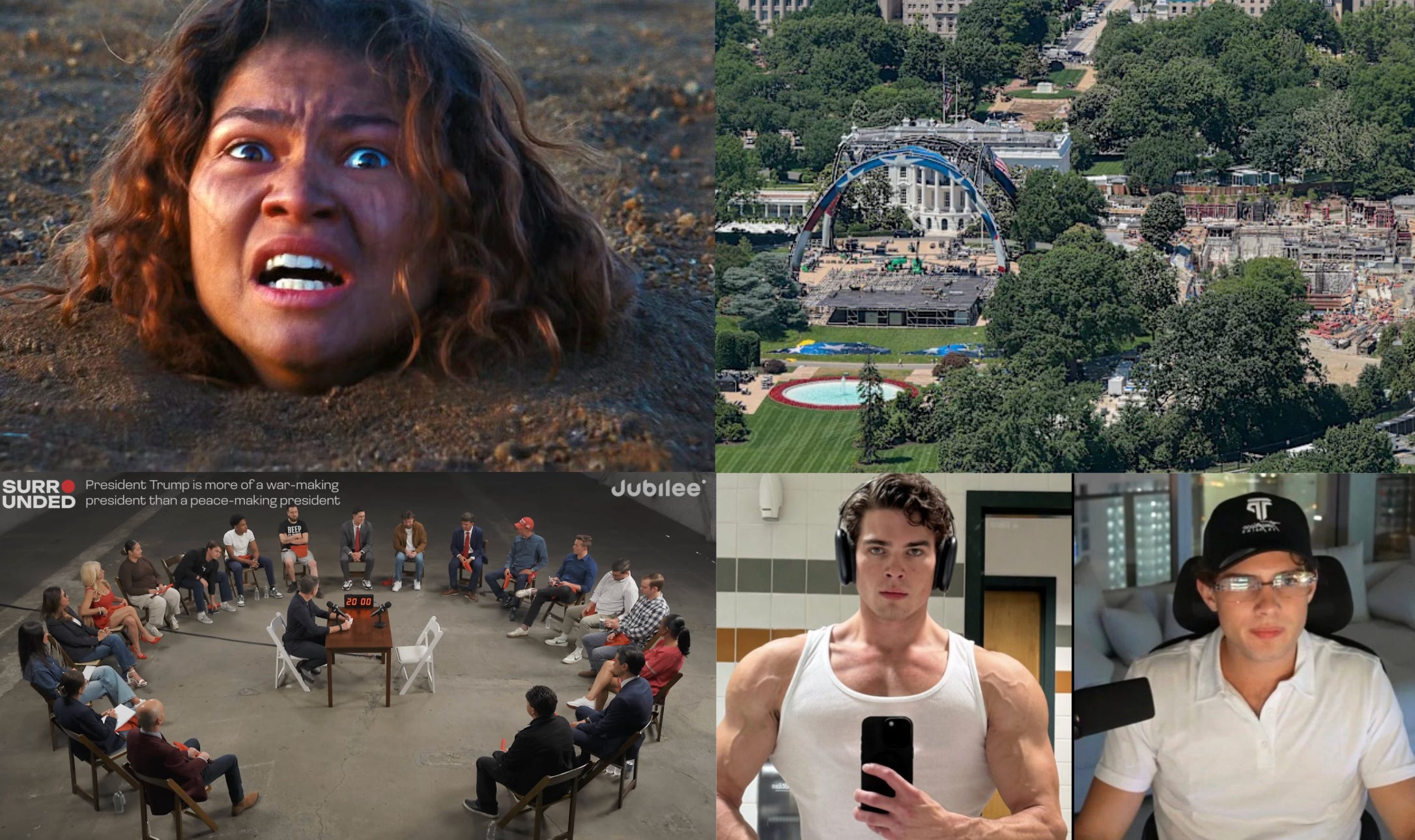
Euphoria Season 3: A sordid, technicolor cornucopia of sex, gratuitous violence and weird OnlyFans kinks. The Onion joked: “‘Euphoria Delivers Happy Ending Where Fans Never Have to Watch ‘Euphoria’ Again.”
Jubilee’s “Surrounded” Series: The popular YouTube pits a prominent political figure against 20 ideologically opposed individuals. The journalist Glenn Greenwald recently described his experience debating “20 Trump Supporters” as a “poop throwing circus” with a “format that reinforces the worst kind of behavior.”
America 250: Speaking of circus—a giant outdoor arena is being erected on the south lawn of the White House to host a UFC Fight in celebration of America’s Semiquincentennial (and Trump’s birthday). Aerial photos of the octagon also show a pit of rubble: the President’s tax-payer funded ballroom. The president also lashed out at what he called “third rate artists” (among them Bret Michaels, Milli Vanilli, and Young MC) who dropped out of the 250 festival.
Drake’s “Ice Man” rollout: The promotional run for the rapper’s new album(s) included a bone-shattering explosion, a giant ice sculpture in Toronto that drew feral crowds, and a “frozen” courtside seat. What followed were 3 albums and 14 new music videos, which Vulture’s Hershal Pandya argued was “so much content [that fans] were no longer sure how they felt about [Drake]…[which is] what happens when you put out so much content that nothing means anything.”
Clavicular: I know, I know. But even this bonesmashing David wannabe is “detransitioning.”
Call it the Banality of Spectacle, where brand campaigns, athletic events and political careers promise intrigue and excellence. The best. The greatest! Ultimately, though, they expose themselves as empty and boring. Instead of cool shit, like Evil Knievel stunts or David Blaine or whatever, we get Fear Buck clips, sperm racing, Ninja Warrior at the Olympics, and a Bezos-backed Met Gala.
The inaugural Enhanced Games, a venture-backed Beast Games with vaguely eugenics undertones where athletes are encouraged to take a cocktail of performance enhancing drugs, provides an apt case study in how spectacle might be losing its luster.
The games were held in a hastily assembled outdoor stadium in Las Vegas, where earworms like LMFAO’s “Party Rock Anthem” blared through the speakers. Here, in this Temu coliseum, 38 of the 42 swimmers, runners, and weightlifters (among them Thor Björnsson, known for his role as “The Mountain” in Game of Thrones) elected to be pumped full of some combination of anabolic steroids, stimulants, and testosterone, all substances banned by the World Doping Agency. The other four rubes competed in their events “clean.”
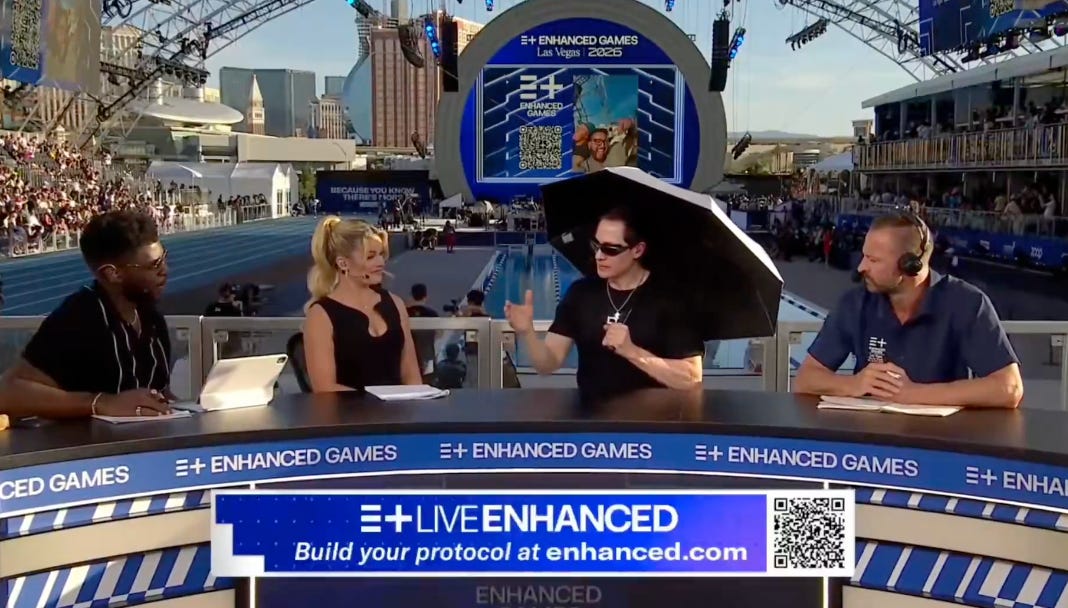
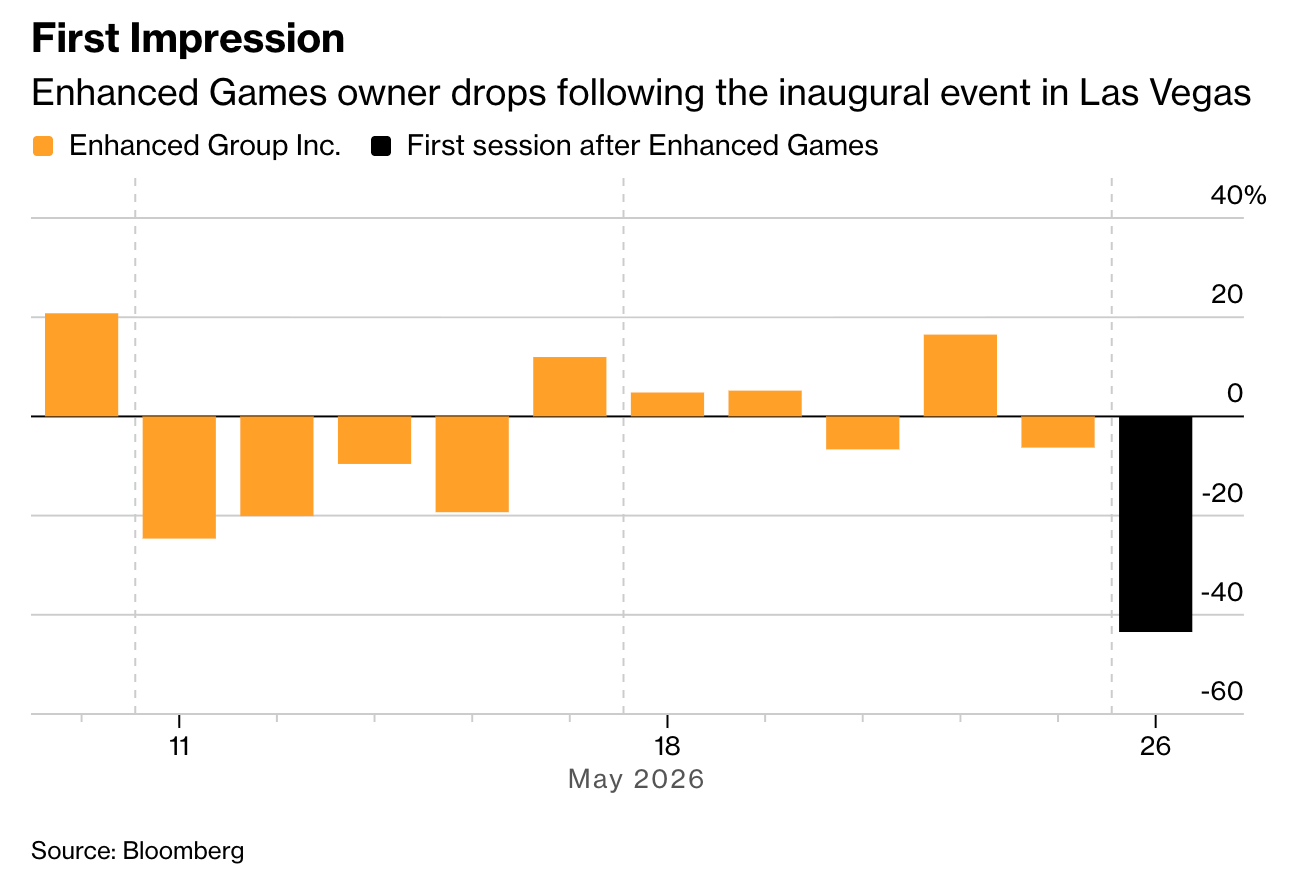
In the end, only one swimmer “broke” a world record, while three non-doping athletes took the podium over their chemically enhanced competition. Boady Santavy, a Canadian weightlifter, was even given a do-over—a do-over!—like when the varsity team gives their scrawny equipment manager some time on the court to take an uncontested shot until they sink a bucket: “Ladies and gentleman, we have a surprise for you. We’re going to give Boady one more chance!” Yahoo!’s Jeff Eisenberg called the whole thing a “glorified infomercial” for sketchy supplements, The New York Times’ Jessica Gross said it was “underwhelming,” Enhanced Group Inc.’s shares fell 43% to its lowest level on record following the event.
Perhaps part of the reason spectacle feels so mundane is because it’s become so ubiquitous. It exists in policy and propaganda, where the war in Iran, ICE raids, and political violence are packaged up into brainrot, revealing a gleeful fetish for violence and casual cruelty.
Closer to our world, spectacle is also a core strategy for brands, who have spent the past five or so years leaning heavily on trying to compete in a fragmented digital landscape with whacky product drops, patronizing ad copy, and horny mascots: Liquid Death’s enema, the Duolingo owl, MSCHF’s big red boots, ads that ask you to “stop hiring humans,” the Polymarket grocery store, etc.
We’ve spent years becoming passive participants, mindlessly sucked into our screens as perverse incentive structures propped up the attention economy and goaded us into ever more extreme and debased behavior. The good news is there seems to be a shift in momentum.
In April, Business Insider reported that Duolingo was shifting its “marketing output from ‘80% unhinged, 20% wholesome’ toward a more balanced approach.” i-D editor-in-chief and former Head of Content at SSENSE recently penned a lengthy mea culpa on his Substack in a post titled “How Memes Ruined Everything,” wrote that “[o]ne must wonder if brands are even getting what they need from these memes, especially as the stunts become higher and higher budget.”
A recalibration of what’s considered to be “best-in-class” social obviously follows. More consumers seem disinclined to reward the kind of attention-seeking behavior we’ve grown so accustomed to seeing from brands. At the top of the charts from the annual “Very Online Survey” that tracks brands with “Great Social” conducted by Link in Bio’s Rachel Karten, were brands with notably discreet and artful output like Ffern, Merit, PBS, and “all public libraries.”
Maybe that’s because, like the athletes “competing” in the Enhanced Games, spectacle as a strategy risks knee-capping credibility, has dubious (probably bad) long term effects, and is artificially enhanced by meaningless metrics.
I once wrote about the banality of our ambition and the banality of spectacle slides right into it. Great. Stuff.